
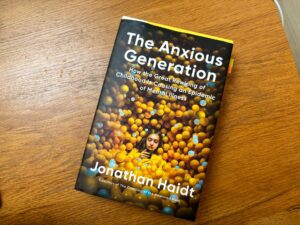
 Reading The Anxious Generation felt less like encountering a new theory and more like seeing language placed around patterns I have been quietly witnessing on campus for years.
Working in higher education, I have observed a noticeable rise in anxiety, fragility around uncertainty, difficulty with conflict navigation, and an overall sense of emotional overwhelm among college-aged students. These are bright, capable young adults, yet many arrive on campus already depleted. Haidt’s argument about the shift from play-based childhood to phone-based childhood resonated because I see the downstream effects daily. Students struggle with unstructured time. They avoid risk. They often experience ordinary academic stress as catastrophic.
What struck me most was not simply the technology argument, but the developmental one. College used to be the place where students learned resilience through trial and error. Increasingly, I see students who have had fewer opportunities to practice independence before arriving. When difficulty comes, their internal coping mechanisms sometimes feel underdeveloped.
That said, I also read the book with caution. The mental health challenges I encounter cannot be attributed to one factor alone. International students navigating immigration uncertainty, first-generation students balancing family expectations, students impacted by pandemic isolation, economic instability, and global unrest all complicate the narrative. Technology is part of the story, but not the entire story.
What the book did for me was validate the urgency of rethinking how institutions respond. If students are arriving more anxious, our orientation models, advising frameworks, and support systems must adjust accordingly. We cannot simply demand resilience. We must teach it intentionally. We must design environments that foster belonging, autonomy, and healthy risk-taking.
Ultimately, The Anxious Generation felt like a starting point for a much larger conversation. From my vantage point in higher education, the rise in mental health concerns is real. The causes are layered. The response must be layered as well.